
Why Woodturning Benefits from Both Online and In-Person Learning
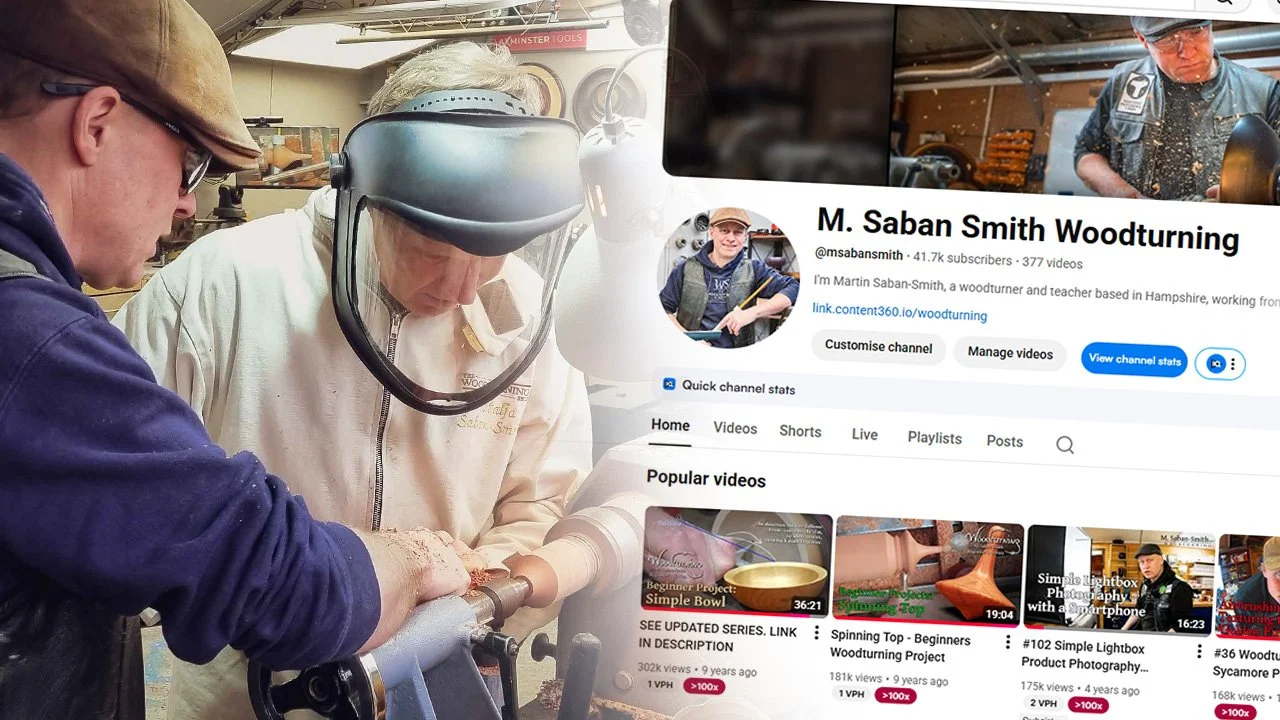
There's a moment in every turner's journey when theory meets timber: When all those YouTube videos you've watched suddenly feel very far away, and the gouge in your hand feels impossibly alien.
I know, because I've been that person. And I've taught plenty of others who've arrived at the workshop having watched every video on the internet, convinced they know exactly what to do... until the lathe starts spinning.
Here's the thing: YouTube is brilliant. Genuinely brilliant. It's given craft skills a second life, democratised knowledge that was once locked behind apprenticeships and guild memberships, and built communities across continents. I've got nearly 300 videos on my own channel, so I'm hardly going to dismiss its value.
But — and this is important — you cannot feel through a screen.
What YouTube Can Teach You
Let's be clear about what online learning does extraordinarily well:
Technique demonstration. You can watch world-class turners work. You can pause, rewind, slow down, and study every movement. You can compare different approaches to the same cut, see variations in tool presentation, and build a mental library of possibilities.
Theory and proportion. The principles of design, like the Rule of Thirds, flow, and balance, all translate beautifully to video. Understanding why something looks right is absolutely something you can learn from your sofa.
Troubleshooting and problem-solving. That catch you keep getting? Someone's made a video about it. That finish that won't behave? There's a tutorial for that. The collective wisdom of the turning community is genuinely transformative. Come to mention it, there’s not much you can’t learn about!
Inspiration and community. Seeing what's possible, discovering makers whose work resonates with you, joining conversations about the craft. All of this feeds your development in ways that matter deeply.
What It Can't
But here's where the screen goes dark:
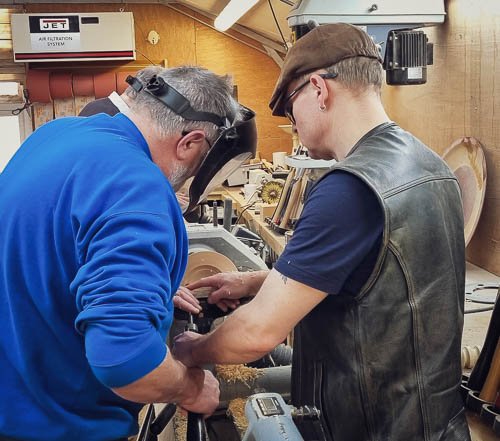
Tool feel. The angle of the bevel on the wood. The pressure required for a clean cut versus the whisper-light touch for finishing. The difference between forcing and guiding. The vibration that tells you something's wrong before you see it. None of this translates to pixels.
Real-time feedback. When you're half a degree off with your gouge presentation, when your stance is causing that shoulder tension, when you're gripping the tool like it's trying to escape: An experienced instructor sees this and gently redirects you before you develop habits that take months to unlearn.
Safety intuition. Yes, you can learn safety rules online. But safety in the workshop is also about developing instincts like reading wood grain for potential catches, understanding when your setup is questionable, and recognising the early warning signs that something's about to go sideways. That comes from working alongside someone who's made (and survived!) every mistake you're about to make.
The texture of learning. Wood is different every time. The piece of ash you're turning today behaves differently from the piece you'll turn tomorrow. Humidity, grain orientation, hidden stresses, character features are all variables that mean that recipes only get you so far. You need someone present to help you adapt this piece right now.
Why I Am Slightly Obsessed About This

I’m a professional turner. It's not a badge I wave around for marketing purposes (though apparently I'm doing exactly that right now, so ignore that bit). It's a commitment to a standard.
That standard recognises a fundamental truth: teaching turning isn't just about being good at turning. It's about understanding how people learn physical skills, how to communicate subtle adjustments, when to intervene and when to let someone struggle productively.
In-person teaching allows us to:
Watch your whole body, not just your hands — because stance, breathing, and tension all affect your turning
Adjust in micro-moments — a word at exactly the right second rather than general advice after the fact
Respond to your actual piece — not a theoretical version, but the specific bit of wood you're holding
Create a holding space for mistakes — because you'll make them, and that's not just okay, it's essential
Build your confidence through presence — turning can be intimidating; having someone beside you who believes you can do this matters more than any tutorial
The Checklist: What Only In-Person Classes Provide
Here's what changes when you work alongside an instructor rather than alongside a screen:
✓ Immediate stance and posture correction — before you've spent six hours embedding bad habits
✓ Tool angle feedback in real time — subtle adjustments that make dramatic differences
✓ Safety oversight tailored to you — not general rules, but awareness of your specific setup and tendencies
✓ Adaptive teaching — we respond to how you learn, not how a generic audience might
✓ Hands-on correction — sometimes we need to guide the tool with you to show what 'right' feels like
✓ Encouragement at exactly the moment doubt creeps in — we see it in your shoulders before you're even aware of it
✓ Permission to make mistakes — not theoretical permission, but actual space to mess up safely
✓ Community learning — watching others struggle with different challenges teaches you things you didn't know you needed
So... Both?
Here's my actual advice: use YouTube voraciously. Watch lots and find a turner who shows good practice. (There are a lot our there who do not!) Build your visual library. Learn theory. Get inspired by the people and the shapes you see. Join online communities. Participate in the conversations that make this craft richer.
And then when you're ready, or perhaps before you think you're ready, come and stand at a lathe with someone who can see what you're doing.
The combination is transformative. Online learning gives you vocabulary and vision. In-person teaching gives you technique, feel, and fluency.
Start Here
If you've been watching videos and thinking about trying woodturning, you're already further along than you realise. You've been building understanding without knowing it.
Now come and discover what can't be taught through a screen.
Book a Beginners Class and get hands-on feedback from instructors who've made every mistake before you and who are quite unreasonably committed to helping you avoid the same.
Related Post: www.msabansmith.com/blog/why-youtube-cant-teach-you-everything