
Turning a Wooden Bowl
A Three Part Guide
Turning a Wooden Bowl
These are exactly the methods I use here at The Woodturning School. They're beginner-friendly, but they'll serve you well no matter how far you take your turning. I've deliberately kept the walls a bit thicker than competition pieces because when you're learning, technique matters more than thin walls. Get comfortable with how the tool moves first. The refinement comes later.
-
-
Your First Bowl: A Three-Part Guide
There's something quietly satisfying about turning a bowl. You start with a rough blank of timber and, through patience and a bit of skill, you reveal something both beautiful and useful. It's one of woodturning's most rewarding projects, and one of the most popular requests I get from students at The Woodturning School.
There's something quietly satisfying about turning a bowl. You start with a rough blank of timber and, through patience and a bit of skill, you reveal something both beautiful and useful. It's one of woodturning's most rewarding projects, and one of the most popular requests I get from students at The Woodturning School.
-
Shaping Your Bowl
In this first video of the series, we work through everything you need to know about turning the outside profile of a beginner's bowl. We start right at the beginning: finding the centre of your blank (which, as you'll discover, is rarely as straightforward as it sounds when your timber isn't quite round), then mounting it securely using a chuck-mounted face plate.
In this first video of the series, we work through everything you need to know about turning the outside profile of a beginner's bowl. We start right at the beginning: finding the centre of your blank (which, as you'll discover, is rarely as straightforward as it sounds when your timber isn't quite round), then mounting it securely using a chuck-mounted face plate.
-
Hollowing Out the Bowl
This second video in the series picks up where we left off. The outside is shaped and finished, the recess is cut, and now we mount the bowl in expansion mode, with the jaws gently gripping from inside that recess. A word of caution here: don't overtighten. All the physics at this point wants to blow the bowl apart, and we'd rather that didn't happen.
This second video in the series picks up where we left off. The outside is shaped and finished, the recess is cut, and now we mount the bowl in expansion mode, with the jaws gently gripping from inside that recess. A word of caution here: don't overtighten. All the physics at this point wants to blow the bowl apart, and we'd rather that didn't happen.
-
Finishing The Bowl
In this final video, we work through a sanding technique using an inertia sander, though the same principles apply if you're using a drill-mounted pad. The key insight is simple: the only purpose of abrasives is to remove the marks of the previous process. Your first grit removes tool marks and any tear-out. Once they're gone, move on. Spending ages on 120 grit won't make the piece any smoother once the tool marks have disappeared. It'll just make the piece slightly smaller.
In this final video, we work through a sanding technique using an inertia sander, though the same principles apply if you're using a drill-mounted pad. The key insight is simple: the only purpose of abrasives is to remove the marks of the previous process. Your first grit removes tool marks and any tear-out. Once they're gone, move on. Spending ages on 120 grit won't make the piece any smoother once the tool marks have disappeared. It'll just make the piece slightly smaller.
-
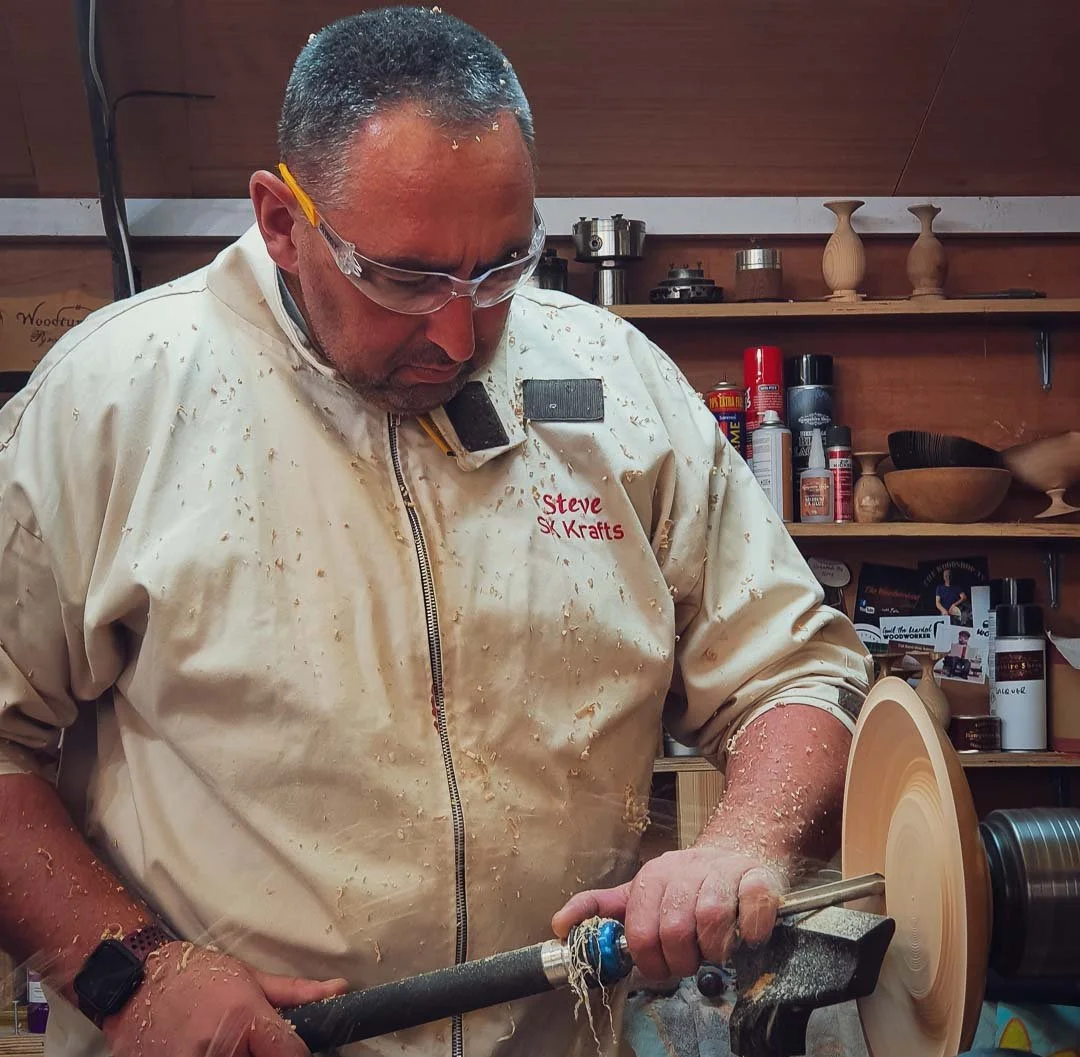
What's included
Part One: Shaping the Outside We start right at the beginning: finding the centre of your blank, mounting it securely, and understanding direction of travel. I'll show you why a 50° bevel angle works well for most turners, and we'll create a recess for chuck mounting. On-screen graphics show exactly where your tool should be positioned through each cut.
Part Two: Hollowing the Inside This is where most people struggle, so I've given it particular attention. You'll learn a pull-cut technique that starts in the centre and works back out in sweeping arcs. I demonstrate from multiple angles and explain why your left hand position matters more than you might think. Get this right, and you'll produce smooth, flowing curves from rim to base.
Part Three: Sanding and Finishing Sanding isn't glamorous, but it's where respect for the craft shows. I'll walk you through grit progression, explain why 400 is your stopping point, and demonstrate a clock-face technique for power sanding that works on both the outside and inside of your bowl. We finish with applying a finish and that moment where you take the piece off the lathe and admire what you've made.